

How To Clean Rust Off An Antique Gun
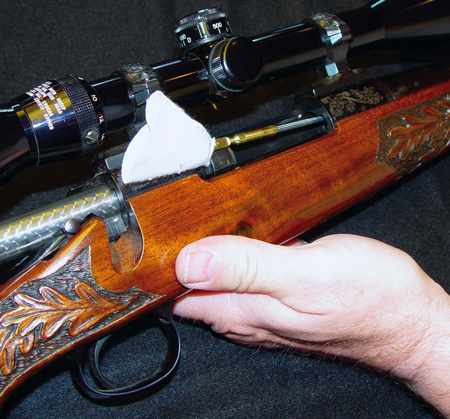
David Arnold, the conservator at the Springfield Armory National Celebrated Site Museum in Springfield, Massachusetts says in that location are a few elementary guidelines to help care for an antique gun – or a drove.
Avoid dramatic swings in relative humidity (RH). Try to keep the humidity stable and between forty and l pct. Consistency is more than important than precise maintenance of a specific RH reading, though RH control is critical because of an unusual physical property of wood called anisotropy. Forest cells expand or contract very differently in response to changes in relative humidity – depending on their specific grain orientation (centric, transverse or radial) in the log from which they came.
Big swings in RH can issue in cracks acquired by pinch-set shrinkage. If the humidity remains fairly constant, changes in temperature make piddling departure to either metal or forest. A rapid rising in temperature, though, can pull the moisture out of the environment (including your artifact), causing a sudden driblet in RH. Prison cell shrinkage and bang-up or splitting can then occur.
Handling
Wear gloves when handling your drove. No protective coating can stand upwardly for long against repeated barehanded handling. Best to always wear gloves and I recommend Nitrile exam gloves when cleaning and blanket your collection. Once an item has been coated, clothing plain cotton wool gloves.
Housekeeping
Go on your firearms grit-free. Dust can trap moisture increasing the likelihood of corrosion occurring.
Don't use commercial dust cloths, though. They often go out an oil film behind which traps grit and dust traps water vapor from the air. When dusting, use either a vacumn with a soft brush or a soft cotton fiber cloth very lightly dampened with water. Without moisture, dust merely gets shoved around and volition not be picked up. Dry the gun immediately with a make clean cloth.
Don't use alcohol of any kind when dusting or cleaning a firearm stock. It tin skin or strip an historic finish. Never use liquid or spray dusting products, either, considering well-nigh of them go out mineral oil behind, which traps dust. Call up that dust traps and collects moisture.
Storage/Brandish
Narrow hooks or loops of wire should non exist used to support drove pieces either in storage, transport or on display. The weight of nearly long arms on such devices is sufficient to crusade indentations in their stock at the points of contact. Instead, use wide, padded supports.
We utilize thin sheets of a closed-cell polyethylene foam material to pad our display fixtures. To avoid mold and mildew during long-term storage, avert at to the lowest degree ii of the three conditions known to promote blossom outbreaks: elevated temperature, however air and elevated humidity.
Cleaning and Blanket: Cleaning Wood Stocks
First, separate the wooden parts from the metallic parts. They are cleaned and coated differently. Unless it should become absolutely necessary, leave the unfinished interior wooden surfaces alone.
Clean the exterior of the stock past placing a few drops of a mild detergent in a gallon of warm distilled water. Apply with a slightly damp soft cloth and rinse with make clean cloths dampened with distilled water. Dry with soft cloths immediately later on rinsing.
Clean again with mineral spirits, using a soft cloth to apply. Exist sure to work in fresh air or a well-ventilated area. Avoid using "oil soaps" equally they tin exist caustic and may impairment an historic oiled surface.
Cleaning Barrels and Other Metal Parts
[Delight notation: I believe that it is essential to practice any new technique on a sacrifi cial piece first, earlier applying it to something irreplaceable.]
Use nylon or brute-bristle bore brushes. Avoid using brass or steel brushes because such difficult materials tin can scratch, simply also might (under certain conditions) cause galvanic (bi-metallic) corrosion (specifically when using a copper-alloy brush on ferrous metals) past leaving a slight metallic smear behind. Use mineral spirits to soften accretions. Piece of work in fresh air or a well ventilated area. (Are there other solvents that are stronger? Yep, simply they are hard to piece of work with safely.) Swab clean with a cloth patch.
Employ only extremely fine abrasives such as oil-free 0000 steel wool. Use only if absolutely necessary to remove stubborn rust or other accretions. Work slowly and watch constantly for whatever changes to the surface. There is ever an element of risk in such work. If yous are at all uncertain, hire a conservator or qualifi ed gunsmith before causing irreversible damage. When cleaning contumely parts, never apply products that contain ammonia.
Ammonia tin can damage old copper alloy materials past corroding them from the within out. In addition, such products may include abrasives, which may testify as well harsh. Elbow grease and mineral spirits should be tried first. If something slightly stronger is needed, effort applying minor amounts of wet tooth powder with a cotton swab and rinse with water. Then – a full general comment about commercial rust removers.
To date, I accept not constitute a rust-removal product that is entirely safety to use on historic metal surfaces. The problem is that nigh rust removers tin can't tell the divergence between iron oxide and atomic number 26 metal, and will get out an etched surface even where in that location is no rust. Some products do seem to come close, though. Often they require extremely close attention and precision – too much for near of us operating on a dwelling house workbench.
In brusque, in that location are no magic solutions that are risk-free and I propose against their use on anything you value. Most surface rust can be removed by first lubricating the area with a low-cal penetrating oil and cleaving it off with a sharp scalpel held at a very depression angle to the metal. It requires close attention, a steady hand, and some patience, but if you are conscientious, you will probably get well-nigh – if not all – of the surface rust off without leaving a scratch. When done, remove whatever remaining oil with mineral spirits.
Disassembly and Reassembly
If yous are organized and systematic you should exist able to safely disassemble and reassemble most firearms successfully. First, probe the floor of every external screw slot with a abrupt point held at a very depression angle. It's amazing how much clay can be packed into a make clean-looking slot. All strange matter must be removed for the screwdriver to practice its best, safest work. A good choice of screwdrivers is a must.
Their tips must exist matched perfectly to each slot in social club to maximize the area of mechanical contact. Taking this precaution volition minimize slippage and the scratching and scarring that tin upshot. The internal shapes of screw slots have changed a lot since their invention and screwdriver tips often have to be ground or filed in society to get a good lucifer. Keep this in listen when regrinding a screwdriver's tip. There are many publications that offer exploded drawings and disassembly/reassembly tips.
At that place is also a bright web site that illustrates with moving images how various types of firearms piece of work.
Coating Stocks
Forest is neither thirsty nor hungry. Information technology is ordinarily covered by a stop that may have get corrupted in some way, thus making it look "dry." The wood below the finish does not need to be "fed," despite what wood-care production commercials may claim. And so never put oil of any kind on an historic finish. In that location may well be unintended just permanently damaging consequences to ignoring this advice.
A cautionary word near linseed oil. Linseed oil takes forever to dry, will trap dust and will not stop water penetration, either. When linseed oil oxidizes, its molecules cross-link with one another, making information technology increasingly more difficult to remove as time passes. Oxidized linseed oil (linoleic acrid) eventually becomes linoxin, improve-known commercially as linoleum!
Repeated, or seasonal, applications eventually develop into a surface that tin look like very dark chocolate-brown alligator peel, and can go nearly impossible to remove. Applying a modern finish over an equivalent celebrated finish can forever misfile the finish "history" of a stock by making it difficult, if non impossible, to tell what (if anything) is original, and what is a restoration material – even with an analytical microscope. Therefore, yous would non want to impact upward, say, a shellac finish with shellac.
Employ paste waxes merely. I prefer carnauba-based furniture waxes such every bit Kiwi Bois, Mohawk or Behlen, or Black Bison on wood stocks. I as well recommend using pigmented paste waxes. "Articulate" waxes can collect in pores and announced every bit white specks against a dark wood background. Equally much as we dear bees and honey, avoid wax mixtures that include a loftier percentage of bee'southward wax when preserving wooden firearm parts. These wax mixtures are non especially harmful, but they are relatively soft (fingerprint hands) and tin be slightly acidic.
Coating Metals
(Note: this advice is strictly for guns which have been "retired" from use and will never be fired.)
Avert using oils. Oil is not the all-time material for long-term protection of collection pieces because it traps dust and dirt, eventually breaks down and has to be periodically replaced. A high quality light oil is fine for maintaining a gun you still shoot. Use a microcrystalline wax, such as Renaissance Wax as a protective blanket. Such a wax is practically inert, remaining stable for a very long time. Apply and vitrify out with a soft cloth or brush. I coat all parts this way, inside and out. Brass parts tin can likewise be coated with wax.
I prefer to utilise Incralac acrylic spray lacquer because it is hands removed with solvents but bonds peculiarly well to copper-blend metals, and will withstand more abuse and last longer than wax.
Pocket-size Stock Repairs
If a split or detached slice of a stock must be repaired, use an adhesive that is both stiff and reversible (i.e., can be safely removed at any time in the hereafter). There is merely 1: traditional hibernate glue.
Do not proceed if there is show that the damaged site has been previously repaired. In this case, if the gun has whatsoever value at all, I recommend that yous consult a conservator. Unless you work with hibernate mucilage every day, make information technology up fresh in small amounts as needed.
It doesn't take long to prepare and it will do a ameliorate job than using quondam glue. Hot hide mucilage is preferable to liquid hide glue as it is less afflicted past humidity. Dampen the surface area to be glued with hot water. Blot the area and wait a few minutes. Then utilise hot glue to both surfaces with a brush and clamp immediately. An appropriate clamp tin can exist as simple as a few pieces of masking record, condom bands, bicycle tire strips or small padded weights.
Employ the least strength needed to practise the job. Clamps can usually be removed in a few hours, just it takes at least 24 hours for the repair to fully harden. Excess glue tin be removed with a lint-gratuitous cloth dampened with hot water. The all-time fourth dimension to do this is commonly correct after removing clamps. If you all the same demand aid, seek the services of a professional person conservator. Contact me or the American Institute for Conservation of Historic & Artistic Works for a referral.
 NEXT STEP: Download Your Free Tempest Tactical Printable Target Pack
62 Printable MOA Targets with DOT Drills - Burglarize Range in YARDS This impressive target pack from our friends at Storm Tactical contains 62 printable targets for rifle and handgun range employ. Target grids and bullseye sizes are in MOA. Ideal for long-range shooting! Become Free Targets

Source: https://gundigest.com/more/classic-guns/simple-guidelines-for-antique-gun-care
Posted by: murrayhistoodespil.blogspot.com
0 Response to "How To Clean Rust Off An Antique Gun"
Post a Comment